The Red Dot Dilemma: Fast, Fun, but Limited
Red dot and reflex sights are incredibly popular on all types of firearms and airguns, and for good reason. They offer an intuitive, fast, and user-friendly aiming experience. With a simple illuminated dot as your aiming point, you can keep both eyes open, maintain full situational awareness, and get on target almost instantly. For plinking, steel challenges, and general shooting inside 50 yards, a red dot is tough to beat.
However, as owners of precision PCP air rifles like our QILIN BP series know, these airguns are capable of impressive accuracy at much greater distances. When you start pushing out to 75 or even 100 yards, the limitations of a 1x red dot become apparent. A 2 MOA (Minute of Angle) dot, which is a common size, covers a 2-inch circle at 100 yards. This can completely obscure the small targets you’re aiming for. Furthermore, without any magnification, positively identifying your target and making precise adjustments becomes a significant challenge.
So, how do you get more performance from your favorite red dot? This guide explores two popular solutions: adding a magnifier behind your red dot or replacing it entirely with a Low Power Variable Optic (LPVO).
As always, remember to practice firearm safety. This content is for adults 18 and over. Always wear eye protection, know your target and what’s behind it, and treat every airgun as if it were loaded.
Solution A: The Red Dot Magnifier Combo
The most direct way to add magnification to your existing setup is with a dedicated red dot magnifier. This is a simple, compact scope designed to be mounted on your rifle’s Picatinny rail, directly behind your red dot sight.
How a Magnifier Works
A magnifier does exactly what its name implies: it magnifies the entire sight picture you see through your red dot, including the dot itself. The most common feature is a “flip-to-side” mount. This hinged mount allows you to keep the magnifier in line with the red dot for magnified shots, and then with a simple push, flip it 90 degrees out of the way for standard 1x red dot use. This gives you the ability to transition between magnified and unmagnified shooting in a split second.
Pros of a Red Dot + Magnifier
- True 1x Performance: When the magnifier is flipped to the side, you retain all the benefits of your red dot—unlimited eye relief, a massive field of view, and lightning-fast, both-eyes-open target acquisition.
- Modularity: You get two systems in one. If you know you’ll be shooting up close, you can leave the magnifier at home to save weight and reduce bulk.
- Cost-Effective: If you already own a red dot you love, adding a quality magnifier is often less expensive than purchasing a high-end LPVO.
- Familiarity: You are still using the same dot and sight picture you’ve trained with, just with the added benefit of magnification when you need it.
Cons and Considerations
- Optical Compromises: You are looking through two separate sets of lenses. This can result in reduced light transmission and a slightly dimmer, less crisp image compared to a single, high-quality scope.
- The Dot Gets Bigger: The magnifier enlarges everything, including the dot. Your 2 MOA dot becomes a 6 MOA dot under a 3x magnifier. While this is still very usable, it can still cover a significant portion of a small target at long range.
- Eye Relief: Unlike the unlimited eye relief of the red dot alone, a magnifier has a fixed and often short eye relief (typically 2-3 inches). You must maintain a consistent cheek weld to get a full sight picture, just like with a traditional scope.
- Weight and Rail Space: This combination adds weight and takes up considerable rail space compared to just a red dot. Alignment is also critical; the magnifier and red dot must be set to the same height (e.g., absolute co-witness or lower 1/3 co-witness) to work correctly.
Solution B: The Low Power Variable Optic (LPVO)
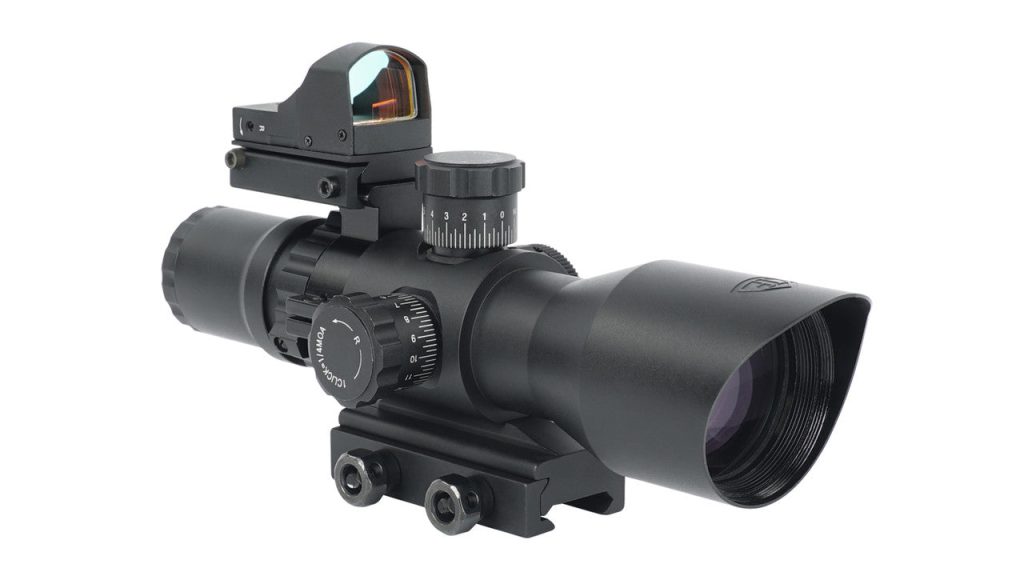
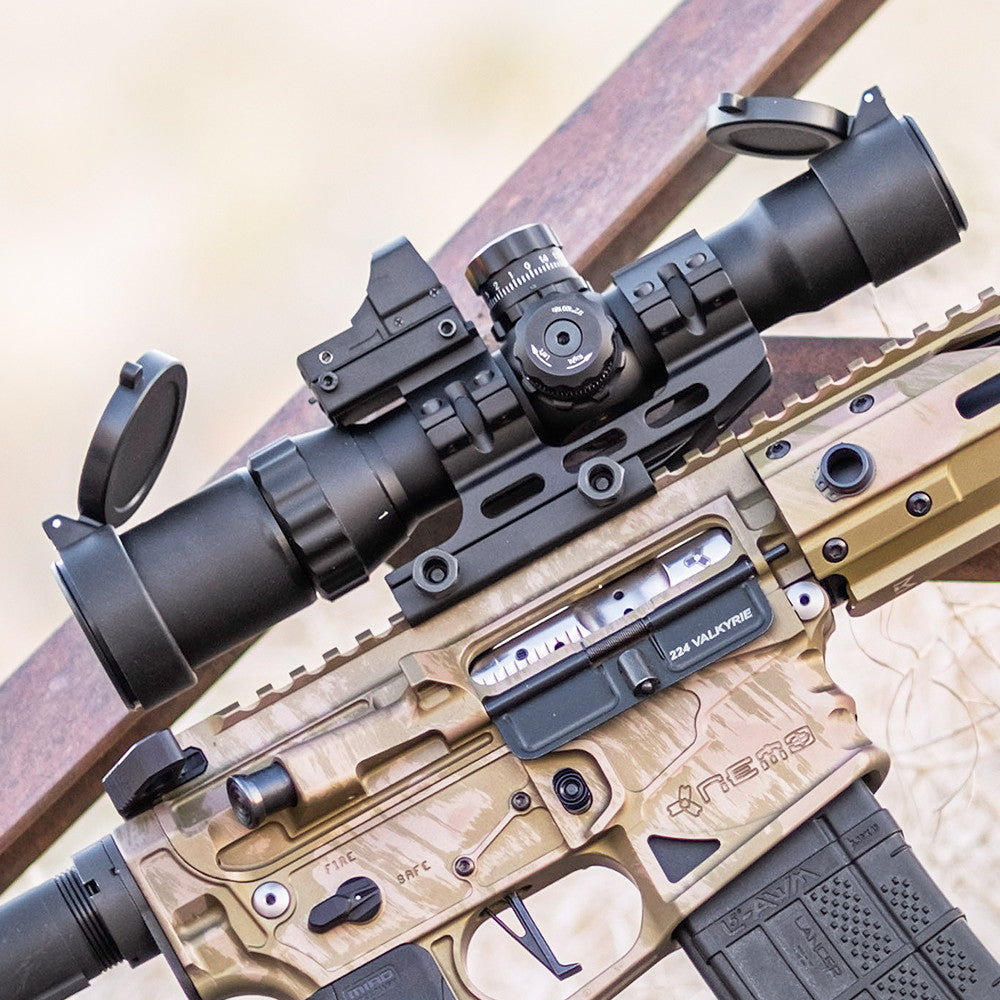
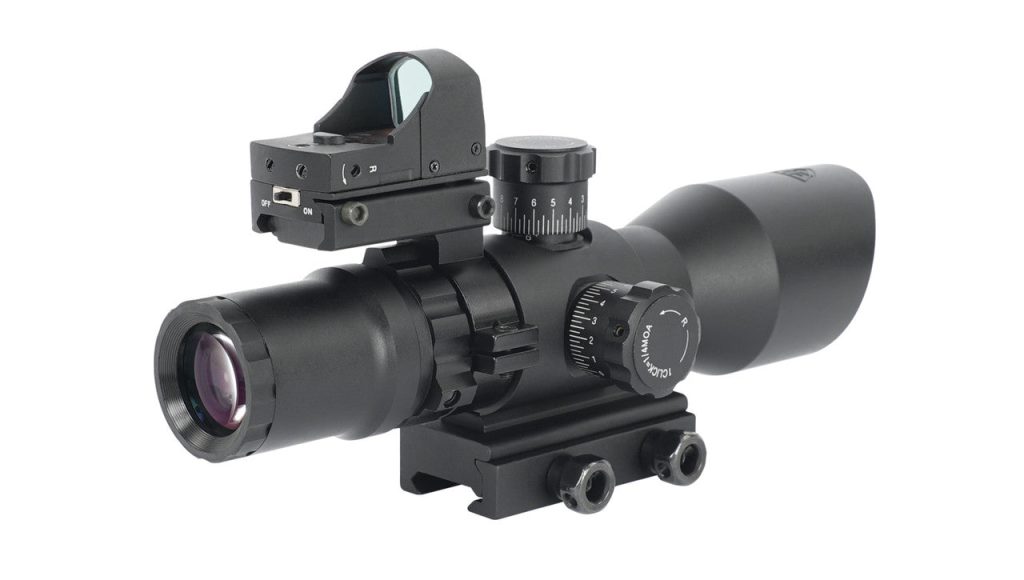
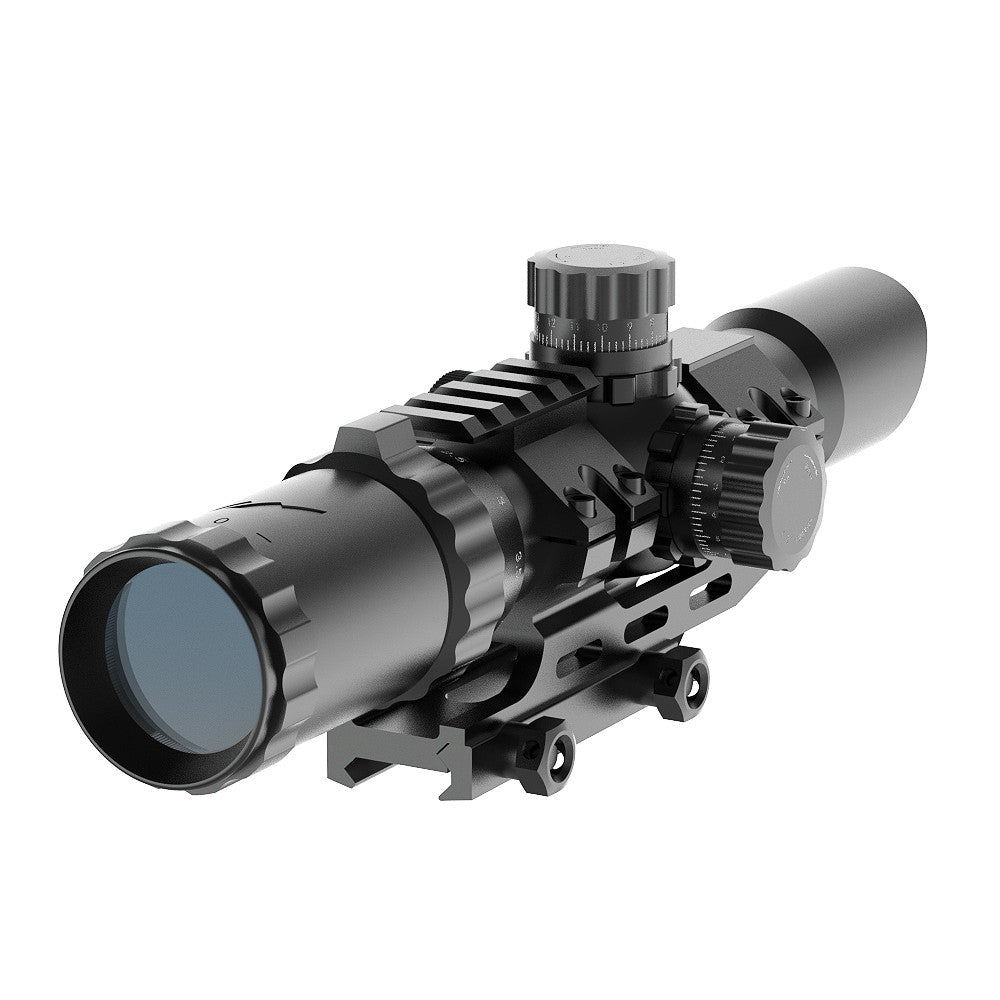
The other popular solution is to replace the red dot setup entirely with a Low Power Variable Optic. An LPVO is a traditional rifle scope with a magnification range that starts at or very close to true 1x, and zooms up to 4x, 6x, 8x, or even 10x on the high end.
How an LPVO Works
An LPVO is an all-in-one package. At its 1x setting, it functions similarly to a red dot, often featuring an illuminated reticle to provide a bright, fast aiming point. As you turn the magnification ring, you zoom in on your target for more precise shots at distance. Unlike a red dot, an LPVO has an etched glass reticle, which means you have an aiming point even if your battery dies. These reticles often include holdover points (in MIL or MOA) to help you compensate for the trajectory of your chosen pellets and slugs.
Pros of an LPVO
- Superior Optical Quality: A single, well-designed scope will almost always provide a brighter, clearer image with better color fidelity than a two-piece red dot and magnifier combination.
- Advanced Reticles: The etched reticle is a major advantage for precision airgunning. You can use the hash marks to accurately account for pellet drop at various distances without adjusting your turrets.
- Seamless Magnification: You can choose any magnification level within the optic’s range (e.g., 1x, 2.5x, 4x, 6x), not just a single fixed magnification like a magnifier provides.
- All-in-One Simplicity: There is only one optic to mount and zero. It’s a cleaner, more robust solution with fewer potential points of failure.
Cons and Considerations
- The 1x Isn’t *Quite* a Red Dot: While very good, the 1x setting on an LPVO still requires you to look through a tube. It has a defined eye relief and eye box, making it slightly slower and less forgiving than a true parallax-free red dot.
- Weight and Size: LPVOs are generally heavier and bulkier than even a red dot/magnifier combo.
- Illumination: The illuminated reticles on LPVOs are often less bright than a dedicated red dot and have much shorter battery lives. Some are not “daylight bright” and function more as a low-light aid.
- Cost: A quality LPVO with good glass, durable construction, and a true 1x setting is a significant investment, often costing more than a red dot and magnifier combined.
Making the Choice for Your PCP Air Rifle
So, which is right for you? It boils down to your primary shooting application. There is no single best answer, but we can make some clear recommendations based on use cases. You can explore a full selection in our optics and sights category.
| Feature | Red Dot + Magnifier | LPVO (Low Power Variable Optic) |
|---|---|---|
| True 1x Speed | Excellent (true reflex sight) | Good to Very Good (defined eye box) |
| Magnified Clarity | Good (two optical systems) | Excellent (one integrated system) |
| Reticle Type | Simple Dot | Complex (Holds for drop/wind) |
| Weight & Bulk | Moderate, modular | Often heavier, single unit |
| Eye Relief | Unlimited (1x), Fixed (Magnified) | Fixed (consistent cheek weld needed) |
| Flexibility | High (flip-to-side, removable) | High (variable zoom ring) |
Choose a Red Dot + Magnifier if: Your shooting is 90% inside 50 yards. You prioritize the speed and situational awareness of a true red dot but want the *option* to take a more precise, longer shot occasionally. You value modularity and may want to run the rifle in its lightest configuration.
Choose an LPVO if: You frequently shoot at a wide variety of distances and need to identify and engage small targets with precision. You need an advanced reticle with holdover marks for long-range airgunning. The rifle is primarily a tool for benchrest shooting or hunting (where permitted), and optical clarity at range is your top priority.
Conclusion
Both red dot/magnifier combos and LPVOs are excellent systems for making a PCP air rifle more versatile. A magnifier enhances a system you already love, prioritizing close-range speed. An LPVO is an all-in-one precision tool that excels at distance while providing a capable 1x setting. Consider your budget, your most common shooting distances, and what you value most—the ultimate speed of a red dot or the long-range precision of a scope. By analyzing your needs honestly, you can make the perfect choice and shop our range with confidence.